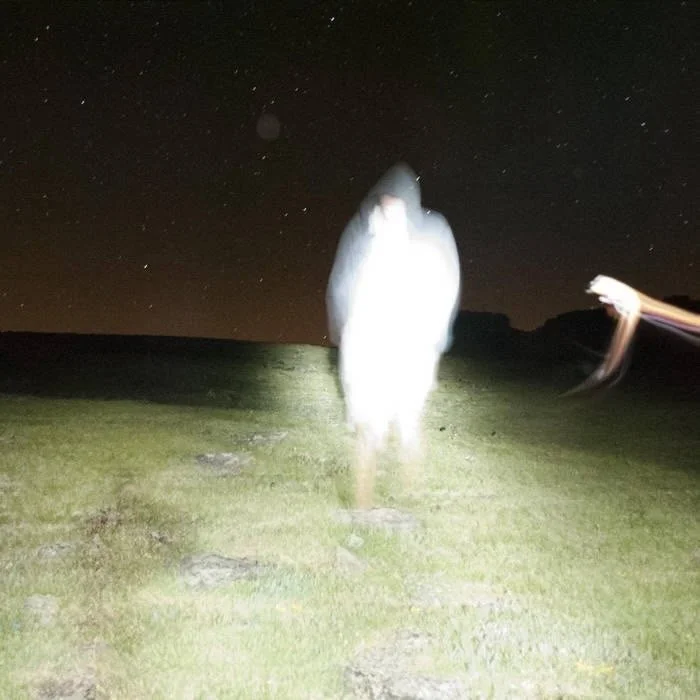
Mt Borracho - The Astral Tunnel
Zach Smith, otherwise known as Mt Borracho, has been pushing his own unique interpretation of noise and ambient music for a number of years now, attempting to capture the ghostly artefacts of tape and other analogue formats to create a sound that is both haunting and familial. The San Antonio resident has been active since 2013, with albums released on labels such as Murmure Intemporel and Structures Without Purpose.
Mt Borracho's Work extends beyond genre conventions, exploring the boundaries and esoteric edges of electronic music. Elements of drone and techno are commonplace throughout, with an emphasis on methodical maturation through live recording. Mt Borracho's latest release on Manchester's Natural Sciences feels like looking up at a treasure trove of corrupted recordings and restricted archival audio. The gritty, ultra-processed interceptions feel like an attempt at extraterrestrial communication, with recognisable sounds stretched and crushed into tectonic shifts and otherworldly growls. Earlier this month, I had the privilege of speaking with Mt Borracho, from San Antonio, about his musical upbringing and stylistic inspirations:
Could you tell us a little about Zach Smith's early life and what music means to him more broadly?
My early life actually began in Los Angeles in the Pasadena neighbourhood. Back then, the city had not reached its density peak and was much more idyllic pre/social media. A lot of primal memories resurfaced when we went back there after we moved to San Antonio. I didn't really fit in much in San Antonio, but I ended up joining the Saysi art program, where I learned how to edit video and audio. And had my first shows. Mt Borrachos’ first scheduled show was set for 2014, but it never came to fruition.
Growing up, my uncle attended many visual-motion-arts parties in London, Spain, and Paris in the 90s, as well as raves. One of which was at a submarine silo. He commented that the best visuals were the most disturbing, chaotic and mind-bending. I feel like so much visual media these days relies on views rather than human emotion, especially in rave culture. Commodification of ideas that shouldn't be so siloed.
What do you think is a key musical coming-of-age moment that shaped your journey?
For some reason, I stumbled upon a Detroit techno YouTube playlist in high school in 2010. And cross-referenced it to other platforms. I was already using VSTS for ambient back then. Fast forward to the 2014 SXSW festival, when I connected with the Red Light Radio crew (Orpheus), who gave me my first booking in Amsterdam, the Netherlands, in 2018. SXSW and the show RLR had at Plush Club were my first rave experiences. There weren't many techno promoters at the time, and I didn't know anyone who made noise.
The other member of Mt Borracho (who I met in 2006) was one of the first noise projects to release noise on Bandcamp. He attended the University of Chicago and was deeply influenced by the scene there. Primarily, I delivered the ambient/rhythmic portions while he did prepared guitar looping / and various other techniques. Including manipulating VHS, and we both would dub to cassette before it was heavily fetishised, as it was in the post-COVID era.
Creatively, he and I differed. While we both wanted to make dissociative music, I yearned to create crazy club music. Similar to what I experienced at Berghain in 2017- and what I saw with Vatican Shadow at Goodroom 2015 on my first solo trip to New York for the lies/ hospitals production show. Cameron was anti-dance music; for me, I wanted not even to create banal noise but rather the "rhythmic noise" that Boomkat called my release for the 10-year embryo box set from Natural Science. It took a long time to develop this style.
In college, I had several Roland keyboards, Ableton, and some drum machines. Later I was able to afford Elektron and some more specific VSTS. In terms of visualisation, Mt Borracho has also been super spacey, weird, and industrial. Specifically, the Intercepted Communication album chronicled found FM sounds with post-war modernism elements of the military city (San Antonio) and coordinates of the USA. Released on Natural Sciences, the Noise War box set remains a cult classic.
Obviously, the paranormal and conspiracy aesthetic is evident throughout my work, including my project mt borracho. I really believe my label, Natural Sciences, Manchester, UK, is a special home for me, and I'm lucky to be there.
What's the vision behind Mt Borracho?
Imminent Headerless data in non-commercial format
Which albums have been inspiring you recently?
In terms of non-dance music, I’m really enjoying Jake Muir’s work and the live set he did at our show by the Pearl District in San Antonio. For dance-related releases, I keep going back to Orlando Voorn’s Luca project with the Closer release. With the basketball hardwood motif in the album artwork.
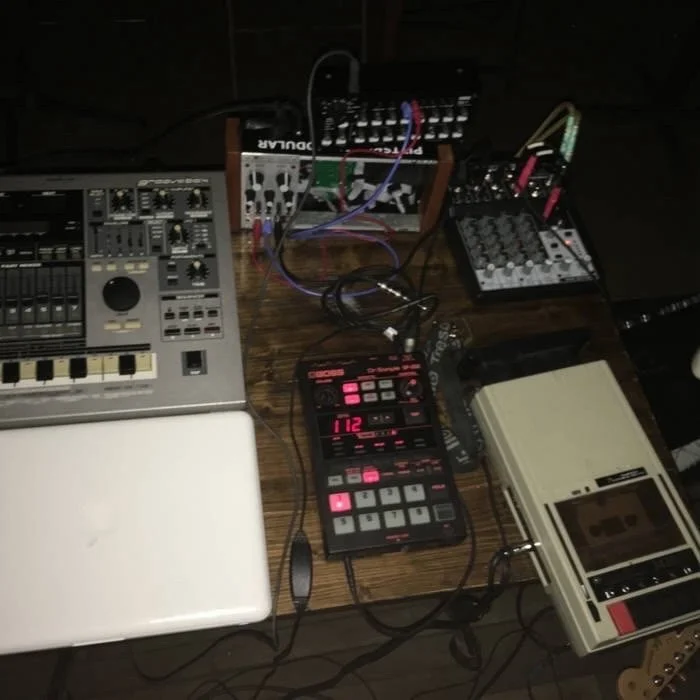
Mt Borracho - Live 2018
What is it about your process that makes you distinct?
Each album is, for the most part, recorded in real time. Or using very little overdub. Also, each recording differs vastly. And with some pretty complicated sampling techniques (spatial, overdubbing of live recordings, data bending). This could be a particular effects pedal, a recording method, or an equality you like, or a vision you keep in mind while producing.
With your recent release of intercepted communications, it felt like there was effort put into mangling and deconstructing radio signals through effects. What does experimentation mean to you, and how free do you think you can be with it?
To me, it's decompressing the modern lexicon that requires a huge budget. Why is something so expensive to public broadcast so lo-fi when deconstructed? To me, that's a paradigm shift that needs to be studied. Rather, I feel like at its core it should be highly complex. FM is so rudimentary compared with neural networks and fibre optics.
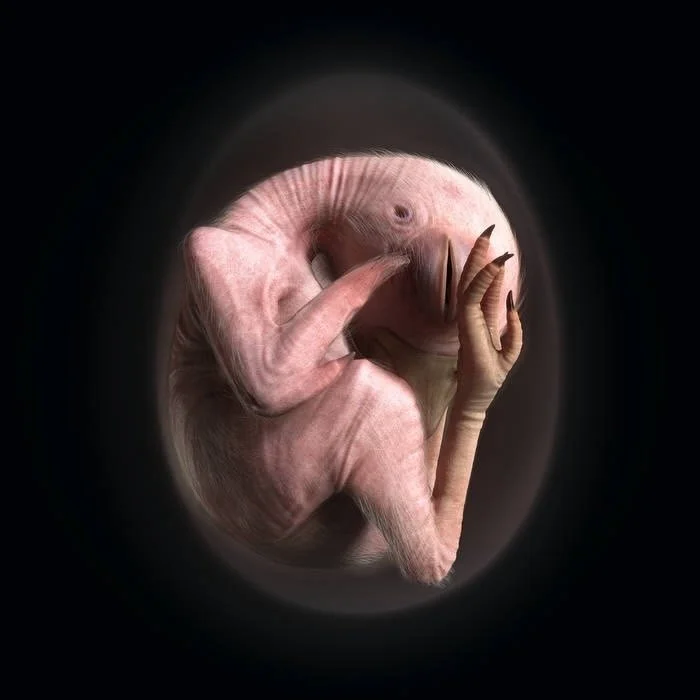
Various Artists - Flesh Renewed
Cassette is a medium that you've used regularly within your productions. Is that purely economical, or is there something aesthetic that has been leading you back to the medium?
I really prefer using tape because it has such a standard, yet chaotic output (especially between manufacturers).
How do you measure your success in a world of underfunded and underappreciated art? And is DIY the way forward?
To me, success is measured not only by the audio aspect but also by the visual aspect of the work. A great example was my show last year at Spanners Club in Brixton, London, with Conrad Pack (Seln) and Jordan Raymond. The club had better sound than any "rave" I've experienced in a long time in the USA, thanks in part to the building's architecture. /ambient reminded me of the raves I attended at Deep Club (Ryan Scannura) events in Denver in 2016 and in 2021 in Brooklyn. As well as the events I attended in Detroit in 2017 at Tangent Gallery. For me, authenticity is super important.
There are a million raves in Austin, but very few of them have the authenticity or depth I think I've experienced elsewhere. Namely, Body Mechanics and Freq System have been great in Austin.
On the San Antonio front, I was lucky in the past few years to play Sonic Transmissions and help book Marcos Cabral with one of my oldest friends, Tones. During the Hexa shows, I collaborated extensively with Justo Cisneros/Jewels and many other artists on visuals.
While Hexa wasn't a label, its collective effort helped me to land my show on 91.7 FM, which lasted several years. The show surveyed the Alamo City and international dance at the time, with releases from heady underground labels and emotional verdicts on the post-COVID 2010s. In-person guests included Fabian Moss, Off the Air crew, Smokey Emery and Willie Burns.
I want to thank Zach again for taking the time to speak to me. You can find out more about his Mt Borracho project on his Bandcamp: https://mtborracho.bandcamp.com/